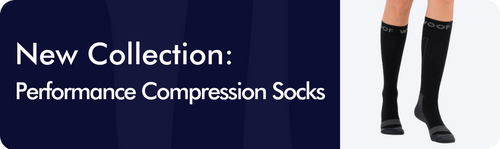


Compression socks for nurses have one job on a 12-hour shift: keep your legs feeling like your legs by hour ten. Ours do it with 15-20 mmHg graduated bamboo that keeps working through the whole shift and the drive home.
These are the nursing compression socks we make for healthcare workers who stand, walk, and pivot through a full day. Every pair comes in Regular, Wide, and Extra Wide calf, so the fit follows your leg.
Why nurses wear compression socks
Graduated compression is firmest at the ankle and eases as it climbs the calf. That gradient supports circulation, nudging blood flow back up toward your heart instead of letting it pool around your feet and ankles through a long shift.
On the floor, that shows up as three things you can feel: less swelling in your feet and ankles, calves that ache less by hour ten, and legs that feel lighter on the drive home.
Long-term standing is also where many nurses first notice varicose or spider veins, and steady support keeps tired, achy legs more comfortable while you are on your feet all day. The same 12-hour math holds for vet nurses, doctors, and nursing students on their feet just as long.
What mmHg do nurses need?
We make our compression socks in one strength: 15-20 mmHg, the moderate range that suits most shift workers without a prescription. It is firm enough to ease swelling and leg fatigue across a 12-hour shift, and gentle enough to reach for pair after pair.
You will also see 20-30 mmHg mentioned online. That is the firmer range, and whether it suits you is a question for your doctor rather than a default setting.
For most people working the hospital floor, the best compression socks for nurses sit in that moderate 15-20 mmHg band. Everything we make lives there, so nothing you add to the cart pushes past it.
Compression socks built for a 12-hour shift
Bamboo is the reason these hold up shift after shift. Our blend is 40% rayon from bamboo, 40% polyester, 12% polyamide, and 8% spandex, which lands soft against the skin and stays sweat-wicking enough to keep your feet dry through a double.
The knit is 360° seamless, so no toe seam digs in under a clog and no vertical seam rubs the front of your leg. The knee-high 35cm cut runs heel to cuff with extra padding at the heel and toe, where blisters start.
Bamboo is naturally antibacterial, which keeps odour down across a night shift. The fabric is breathable, hypoallergenic, and quick to dry between shifts.
Fit and calf sizing
Fit is where compression socks succeed or fail, and calf width matters as much as shoe size. Measure the widest part of your calf before you order, ideally in the morning before any swelling, then match it to our compression socks sizing chart.
Every design comes in Regular and Wide calf, and a few classic colours (black, white, and baby pink) add an Extra Wide option. Sizes run Small, Medium, and Large by shoe size, so most nurses land their fit on the first try. If you are between sizes, size up.
Most nurses reach for the knee-high length, but the same 15-20 mmHg comes in crew and ankle heights if you want less coverage under trousers.
Prints that pass the dress code
Your scrubs might be prescribed, but your socks usually are not. That is where nurses get some personality: florals like Daisy Delight and Flower Power, animal prints like Sugar Gliders and In the Jungle, easygoing designs like Good Vibes, cause collections that give back, and classic black and navy for a stricter dress code.
The rest of your long-shift kit
With your calf width and 15-20 mmHg strength sorted, the socks are handled. Browse our cute printed scrubs if you want to add more color to your shift, add a scrub cap to the order, and layer an underscrub under your top for the coldest wards.
Read more ↓